Friday, September 26, 2014

For the Week of 9/22


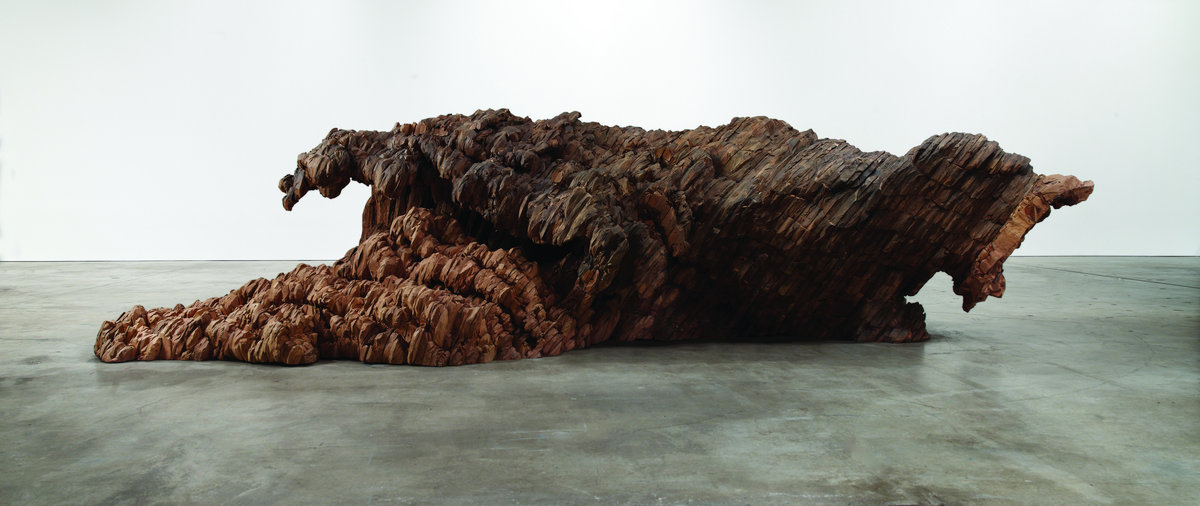
         (Above: Piece by Ursula von Rydingsvard . I love this particular piece, but I love her work even more when its placed out in nature. Stunning! )

Art 21; Mark Dion, Iñigo Manglano-Ovalle, and Ursula von Rydingsvard
     Mark Dion focuses a lot on "stuff" in his work. By placing and arranging both unique and plain household items in an instillation, Dion creates life like scenes from mysterious times and places. His work is also very focused on ecology, one of his best known pieces, Neukom Vivarium, focuses on the complex and delicate processes required to create life on this planet.
     Iñigo Manglano-Ovalle creates video instillation and sculpture pieces often times making use of metaphors and symbolism. While he gets a lot of his inspiration from nature, a lot of his work seems really industrialized, modern, or architecturalized, such as in his piece Random Sky.
     Ursula von Rydingsvard was the last artist we looked at this week, and also my favorite. She attacks ecological subjects by making natural wood sculptures resembling organic forms. The layering techniques she uses to create the colors in her pieces is not only extremely complicated and tedious, the end result is beautiful.While she uses a team of people to help create her vision, her pieces are enormous. I have always been a fan of natural wood works, but I have never seen it done this way before. While the individual pieces are ragged and rough, the layers make the overall image look rich, moist, and living.
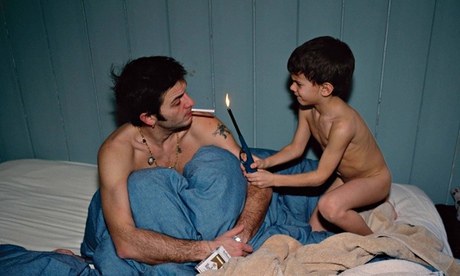
   

 (Left: Lou Lighting Aurele’s Cigarette, Nan Goldin. I just don't get anything from some of her photographs.)


Readings; Nan Goldin, Shirin Neshat
     This weeks readings were some what uninteresting to me. The artists Nan Goldin and Shirin Neshat are both photographers, though their backgrounds differ drastically. Nan Goldin grew up in Boston, Massachusetts, born to Jewish parents. An early source of inspiration for her came from a trip to Boston's gay and transsexual community. You can also see the role her urban environment has had on her work, as she now resides in NYC, Berlin, and Paris.
     Shirin Neshat is an Iranian artist who focuses her art on more political issues. Her inspiration often times comes from religion and racism, as well as feminism.
   
(Right: Fervor, Shirin Neshat. This is one of the pieces by Shirin I really enjoy.)

I feel like my "happy place" lies some where between these two artists. While Nan Goldin goes to the extreme to show people shocking images of the gritty underbelly of society, Shirin Neshat's work is almost too pretty to interest me. With Nan's work, the images provide little stimulation for me, they don't really make me feel any kind of way. I feel like the dark and personal subject matter shown in these pictures can have a powerful impact on the viewer, but I feel her photos lack many artistic elements. There is usually very little symmetry or balance, the lighting is natural, the subjects are performing daily tasks, and the composition of many of the photographs are uninteresting, almost perfectly centered shots, as if you were taking photo's for a Facebook Icon or something. I feel bad criticizing such a successful artist, but I am not a fan.
     While I appreciate Shirin's work more as art, It comes off as a little commercial. A lot of her popular photographs of women with writing covering their bodies is a well used subject in pop culture and the art world today.

Class Notes
     This week we have been looking a lot at ecology and what some artists are doing to incorporate ecology in their work.I had some what of an idea of what I wanted to do for the upcoming ecology project, but after seeing some of Andy Goldsworthy's work, I am unsure. I was so inspired by his pieces, it slightly changed the way I wanted to go about this project. At first I was hoping to do something involving an urban environment, but now I would like to create something more organic.
     On Thursday we went to the McColl center, but unfortunately I didn't feel a connection with any of the art on display.

Wednesday, September 24, 2014

Ideas for Ecology Project

     Our next project is ecology. We were given the assignment to create a piece that examines nature, or how organism interact in their environment.The project should be presented in a series of around 20 photographs.

1. Photographs of earth to form an other worldly experience. I really am into ecology of other worlds in video games, books, and movies, so I began rolling this idea around in my head. The goal would be to compile a series of pictures that accentuate the small and beautiful eccentricities of earth we often over look. these features of our planet can seem to be other worldly or fantasy-based at times.

2. Photographs of plants and animals taking advantage of urban environments. For this idea I thought it could be fun to go down town, walk around, and find examples of plants, animals, and humans alike interacting with man-made structures. This is risky however. If I couldn't find interesting subjects withing my restricted travel-area, this would make a boring collection.

3. Organic Sculpture. For this I would create a non-objective sculpture using natural material. I started thinking about this after some reading on Andy Goldsworthy.

Sunday, September 21, 2014

For the week of 9/16

Art 21; Martin Puryear, Kara Walker, Sally Mann
     This week we were to look at three artists on Art 21; Martin Puryear, Kara Walker, and Sally Mann.Kara walker works in all sorts of medium, creating art influenced by her interest in slaves in history, and Martin Puryear prefers to create abstract sculptural pieces. Sally Mann's work was the most interesting to me. I think her idea's on art from the roots are unique as a prominent artist, where art is seen as a practice to create something fun and beautiful rather than something critical and instigating. She is also noted as an artist for taking a series of suggestive photos of her children. While controversial, the  photographs make people stop and think about the purpose of the pictures, how the pictures impact us, and why they have that impact on us. Sally feels her pictures are simple, beautiful, and innocent, which points the finger at us, the audience, to interpret the art she had so much joy and fun creating. I feel like this is what makes good art.

Reading; William Kentridge, Chris Ofili
     This week we read about the artist William Kentridge. William is a South African artist, mostly known for his drawings and animations. Kentridge, being a Caucasian man growing up in the apartheid, was highly influenced by the atrocities he saw around him. His work reflects sadness and anxiety through the use of his smudged, dreary looking mediums, often times Charcoal. His work to me is not very visually appealing, a lot of it reminds me of images from the holocaust; depressing, grungy, and jerky, which gives the illusion of dated equipment. The work is interesting to me though, I feel like his work is powerful, I can feel the oppression whenever I look at it.
     We also briefly looked at Chris Ofili, who created paintings notoriously composed along with elephant dung. Chris's African/Caribbean heritage is reflected in his work.

Class notes
     This week we mainly worked on our time projects. I was not a fan of the way we reviewed our peers work this week by rotating chairs and writing a comment for every one after reading their sketchbook. I know I missed some people, and I feel like the comments weren't very genuine. A lot of people seemed to be writing something quick and generic, then moving on in an attempt to comment on every single persons in the allotted amount of time.

(Below: Martin Puryear Sculpture, I  lOVE  his work!)


Reflection on Time Project Presentation Day

     This weeks time projects were a TON better than the play projects of the first week. I think it was easier to relate time to art, than play to art for a lot of people. The stop animation video of the Frankenstein's monster was amazing, and you can tell a lot of time and work was put into the piece. I also really liked the idea of the "therapy through make up" piece. While more time would have helped every one achieve a more finished product, the idea and images I was shown seemed very sweet and private at the same time. It also seemed to effortlessly comment on time, vanity, and the artists own interests.

Monday, September 15, 2014

The Potato.

     Our assignment 2 was given to us last week, it was to be based around time. Ironic, seeing as how I have no time to myself anymore. All of my professors seem to think I am taking only one class this semester; theirs. None the less, I have successfully completed my assignment; Monday, September 16, 12:28 AM.

The Potato.

     The most important thing in art to me is meaning. Whether that be functionally, "why is that fictional monster/society/weapon/etc. portrayed that way?", or symbolically. For this assignment I wanted to address time in a symbolic way. I began thinking about time and how it is affected by certain events, since I wanted to avoid the over done "circle of life" genre of crap. Since every one in class seems to be doing something specific, I wanted to do something broad, something any one can relate to. I had a beautiful vision; A girl sitting on the beach waiting for some one. Its morning, time stands still, sea life is quiet. Then, to the girls' delight, a boy arrives. Filled with joy, the girls' world is put in fast-motion. The sun springs up, and the birds and fishies and crabbies are scuttling about. I wanted to capture the sensation I feel when around certain people in my own life.

     Unfortunately that was just a passing dream, and after I dragged myself home from another 12 hour shift, I plopped down and got to work on what really had to be done. The potato. I decided to do something simple, something fast. My good computer that runs my adobe flash animator is KO-ed at the moment, so I had to visit the museum of ancient technology to reclaim my lap top that lags and freezes too much to use adobe. So potato sounded good. Round, mis-shapen, something quick. The idea actually began growing on me, no pun intended. I imagined originally a potato growing old, withering, and molding in fabulous colors in my mind. I saw funky shrooms and crazy flowers blooming out of the rotting spud.

     But then again, 12 frames in, I grew tired and let my mind wander and do the silly things that it do. A worm grew out of a scribble I mistakenly drew, and then I just dont know.

     Atleast this project, if nothing else, shows the effect that time has on my mind after a "fully loaded" weekend of work and school. Pun very much intended.

What have I done....    ._.
(This looks more visible on youtube.)
https://www.youtube.com/watch?v=umjvmjoqXmQ&feature=youtu.be


Friday, September 5, 2014

Reflection on "Play" Projects

Play

     After presentation day of our first projects, I was really impressed by some of the creativity in the room. All of the projects were fun, which made for an interesting day. I was extremely nervous in presenting mine, and I did not expect there to be a 2 minute time limit.

     The first member of my group to present was Jeff. Jeff asked every body to draw how we see ourselves on large note cards. Then he took the pieces and assembled them onto a tri-fold for display. This was a very fun activity, every one seemed to be enjoying the task. I still feel that the project needed more exploration or learning. I feel like in a project about "play", interaction with other people is very important. It would have been more stimulating if we were asked to draw some one else in the room, but only if we DID NOT know their name. While this might seem like "judging based on appearance", it trains drawing skills by forcing us to draw people who's features we are unfamiliar with. It also would provoke spontaneous interaction by forcing some one to approach new people, thus improving social skills and overall mental health.

     Drew went after Jeff. While Drew's project seemed somewhat unsuccessful during the presentation, he too was unaware of the 2 minute presentation time. I feel his piece would have been very successful if we had done the presentations more "gallery style", letting people wander about and examine the pieces on their own. Drew's piece was a simple cluster of Lego blocks. He glued some of the pieces together though, forcing the viewer to think more critically about how to construct desired shapes. I feel like this was a good example of a game adults can play and enjoy, while having both intellectual merit and visual aesthetics.

      Tom was the last person in my group to present. I feel like the concept of trophies could have been a very good starting point, but I did not entirely understand the concept. Tom sat at a public bench and polished a large collection of thrift-ed trophies while recording himself on camera. By polishing the trophies mostly alone, I did not see the element of "playing" strongly represented. Also, he sat in public, but not a very busy area. The project would have been much more entertaining if Tom were to have pushed harder for a reaction from people. I think taking a negative approach to "play" could have been ingenious, and maybe the trophies could have touched on the idea that kids are rewarded too often these days for unimpressive achievements. As the project is, however, I was not a huge fan. I will say that the end project video was appealing; shining trophies, layer after layer, slowly filling up the camera screen, but the goals of the project at the core was lost in my opinion.


Project 1: Play

     Our first assignment was to create a conceptual piece of artwork inspired by "play". While many of my professors seem to think hashing over countless ideas and documenting anything that flutters through the mind while brainstorming are efficient techniques, different strategies work better for me to conceptualize my art works. For this project I began just relaxing in my free time and thinking about what I used to play when I was a child. I tried to avoid the predictability of board games or kiddie crafts. After I got my basic idea, I push and pull the idea around in my head until I feel it is complete.
     Eventually I decided to make an interactive game. When I thought of play as a form of art, I thought of creating something through a fun interaction, that also trains the mind and body in some way. Art is creation, and playing is a puzzle, so I wanted the piece to have some level of difficulty.


     To the left is an instillation by Quynh Vantu. The boards were hung perfectly at her petite, 5" height. This way, people passing through her museum space could see how she sees the world for a short time. Quynh Vantu's work reflects a cleverness and humor I admire in an artist.


     Eventually I came up with an idea to make a giant Cats' Cradle. I figured this game was perfect to replicate because it is not only challenging, the player creates a piece of artwork. There is also emphasis on the MOMENT of creation. Like an idea, a string takes shape into a beautiful piece of art, and in seconds it can be destroyed and returned to an ordinary string. I feel that by making the string large enough for many people to share, a group of people can create together. There are also many complex forms that can be made with a cats cradle, so it can be a learning tool to better problem solving, communication, and observation skills.

     When it came time to purchase my 2$ roll of ribbon, I decided to choose a bright red. I decided this, because the ribbon reminded me of an eastern Asian folktale. The red string of fate; where lovers and people who are meant to be together are connected by a spiritual red string. The string bends and tangles, but it will never break. Not only does this play off of my love for Asian art, It surprisingly reminded me of something unexpected from my childhood. When kids would pick the pedals off of flowers, and alternate "He loves me. he loves me not. He loves me." I think it would be a quaint and humorous touch in an exhibition of my final piece, if there were instructions to creating the string shapes hanging on the wall, along with many large pieces of string. Families and friends could start all holding the strings, then as the string takes shape, some fingers are often dropped off and no longer used. By the end of the shape, the group creating together can see which people are still holding onto the ribbon, and therefor destined to be together forever.

Below is several pictures of my ribbon, which on its own is quite striking, in my opinion. I love my piece; not only is it a tedious interactive puzzle game, it holds beautiful meaning, and every time some one picks it up, no matter how talented they might be, they can feel like an artist creating something special with their loved ones. The bottom right picture shows a simple string shape known as the Witches broom.