
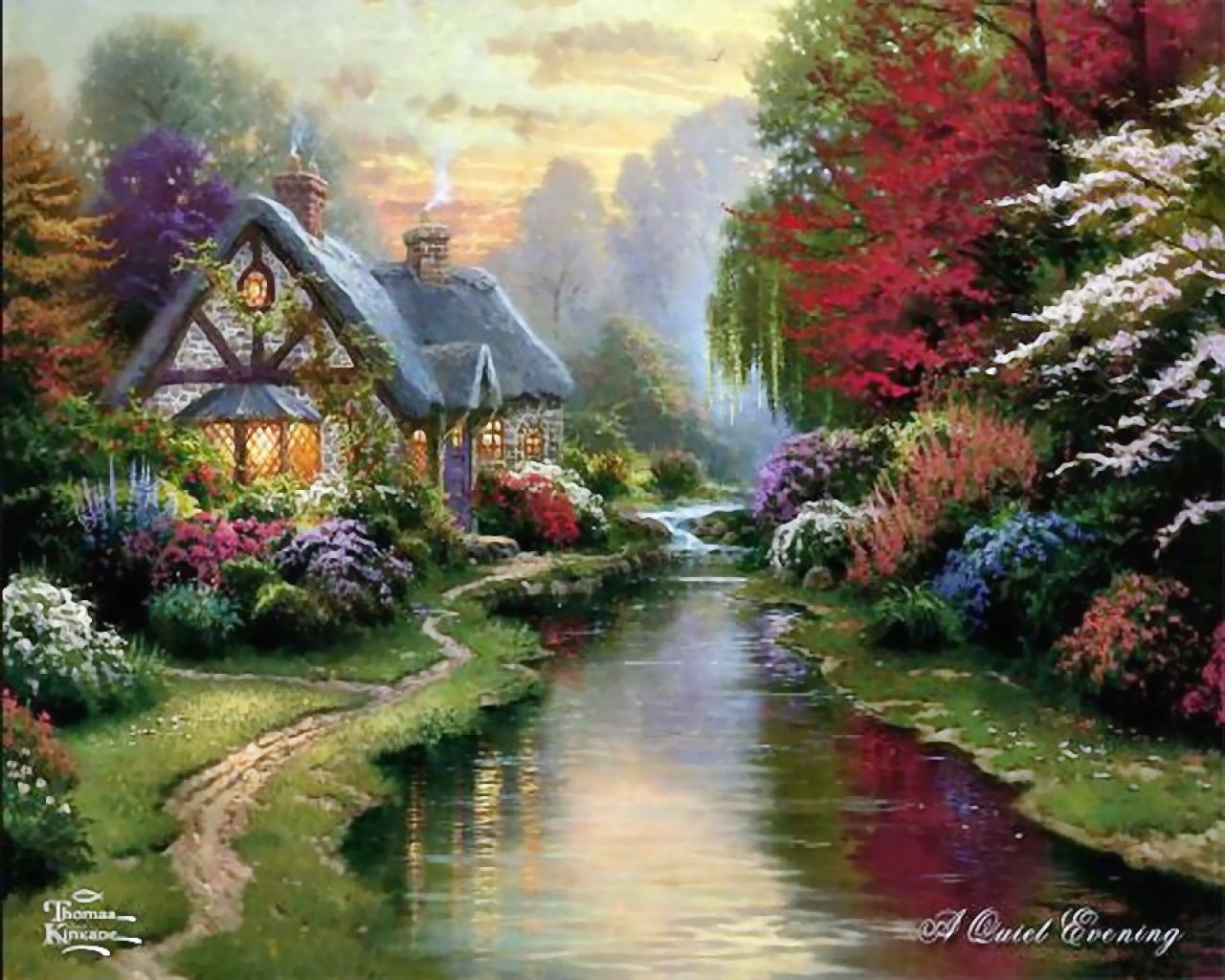

The first artists discussed in our books were Thomas Kinkade and Charles Ray. While they are both artists, debate ably, they go about their work in completely different ways, and their purpose in doing art differ as well.While both were educated, Thomas Kinkade strives to give art to everyday people, while Charles Ray aims to not sell his art at all, but inspire people by moments he captures in time. While I cannot say I am a fan of either artists, I find Thomas's work to be more interesting. By the descriptions given in my book, I was compelled to research more of Rays' work, curiously seeking the shock value.
(Upper left: Thomas Kinkade, "A quiet Evening. Lower Right: Charles Ray, "Shelf".)
After the discussion in class, I feel the general consensus was that people saw Kinkade as a good man and businessman alike, while Ray was a *rolls eyes* "Artist" *cough cough*. Eventually the discussion got away from general "what we think" of the artists, to why we see them as what we see them. Then I began thinking about what I believe makes art, and what makes an artist. I heard a lot of good idea's on discussion day about the artists, but what I most agree with is that there are simply different kinds of artists. Moms with too much time on their hands and a few dozen editions of Home and Garden might see themselves as artists helping their kids make Popsicle stick bird houses, while "fine" artists are more involved in the process.
Aside of the discussion about the book, we also did an interesting activity in class. We were given a few materials and asked to play. It was fun, after remembering how to play again. We thought about the meaning of play, and how it affects art. It reminded me of how closed off my mind is from my curiosity, despite of how "open" and "original" and "artsy fartsy" I thought I was. Not calling any one out, but the standardized school system sure as hell didn't help "broaden my horizons".

Play
Verb.
1. engage in activity for enjoyment and recreation rather than a serious or practical purpose.
Art 21
Jessica Stockholder is a sculpture artist, who started as a paper maker. Her artwork is installed on a larger scale, about the proportions of rooms or furniture. It seems she focuses on plastic looking colors, and the concept of play. I find her art very enjoyable, it looks as if everything came out of a toy box. You can see while she is creating her art how much thought she puts into it. During her segment on Art 21, she emphasizes how important she deems playing. I think a lot of people feel like playing is childish and pointless, while Jessica feels it trains the body. It can train our bodies to think on intuition, rather than using only our minds.
"What's intuition? You know? Its a kind of thinking. It's not stupidity." - Jessica Stockholder
Arturo Herrera's take on play is less literal than that of Jessica Stockholders, but still intriguing. I think its interesting that he started making collages because he lacked financial support and the space. This on its own embodies play, in the fact that he found ways to create when he lacked materials.His art just looks like fun. He has an enormous scrap paper collection he uses to inspire him. Herrera mixes and matches the pieces together until the art speaks to him. I also think it is interesting that he is influenced by cartoons, what most would consider a childish curiosity. Herrera also is a photographer, more focusing on the techniques to alter the photo's rather than the subject. While the end product might not look like anything special to some people, after seeing Herrera's process, I have an extreme respect for him. I love his work, and although it appears effortless, each piece has strong emotional value to the artist, and represents a learning experience for the body.
(Top: Jessica Stockholder,
"Vortex in the Play of Theatre with Real Passion: In Memory of Kay Stockholder, 2000".
Bottom: Arturo Herrera.)


I have to say, I'm impressed by your presentation in this blog post. Interesting insight on Kinkade vs Ray, though you ended up generalizing artists by a huge margin. If there are different kinds of artists, what kind are you? What kind do you want to be?
ReplyDeleteI agree that the "Play" exercise broadened our/my perspective. I never noticed how it had narrowed so much over the course of time. I hope that we can retain this experience far into the future!
I just noticed this comment, better late than never I suppose. Sorry! Im so new to blogger... and blogging... and technology.. and electrici- But yeah I think there are different kinds of artists. I see myself as a practical artist. I want to make things other people like more than I like. I also want people to use my creations, not just look at them. But at the same time, I want to get recognition for my own talents. I couldn't see myself turning into a business man like Kinkade. :c
Delete